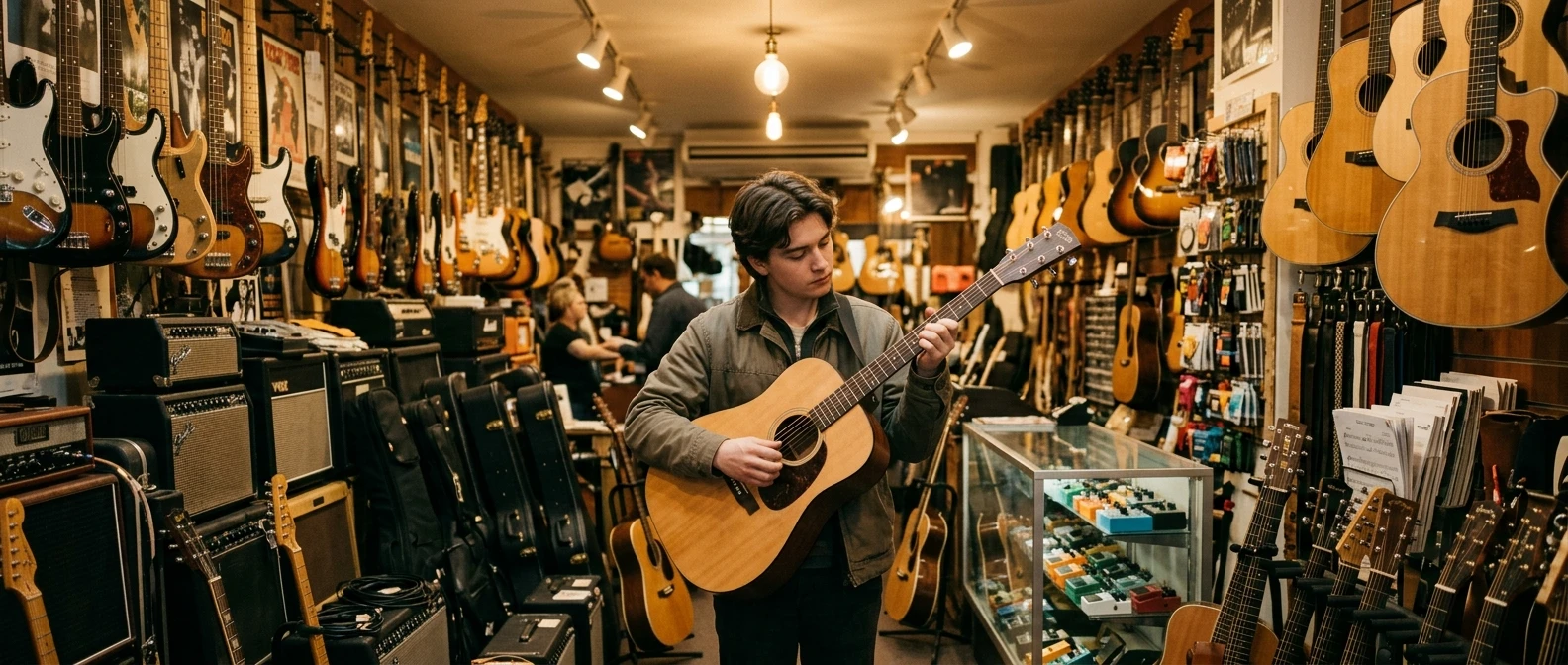
Is the Guitar setup properly?!
Most people who quit guitar in the first month do not quit because practice is hard. They quit because the instrument in their hands is fighting them: strings sitting a mile above the fretboard, a neck too wide for their hand, tuning so far off that every chord sounds wrong even when their fingers are right. The gear mistake that ends more beginners than bad advice or busy schedules is buying an instrument that makes the first three weeks physically harder than they need to be.
This matters more than which brand of strings you buy or whether your amp has reverb. Get the instrument and the handful of supporting items right, and the normal frustration of learning something new is the only frustration you’ll feel. Get them wrong, and you’ll blame your fingers for a problem that was sitting in the setup the whole time.
Do you actually need an acoustic or electric first?
There’s no correct answer here that applies to everyone, and most of the advice you’ll find online picks a side and defends it. The real question is simpler: which sound made you want to learn in the first place?
If you picture yourself playing campfire songs, singing along, or sitting on a couch working through chords, an acoustic makes sense. You plug in nothing, you need nothing else, and the sound you get is the sound you’ll play.
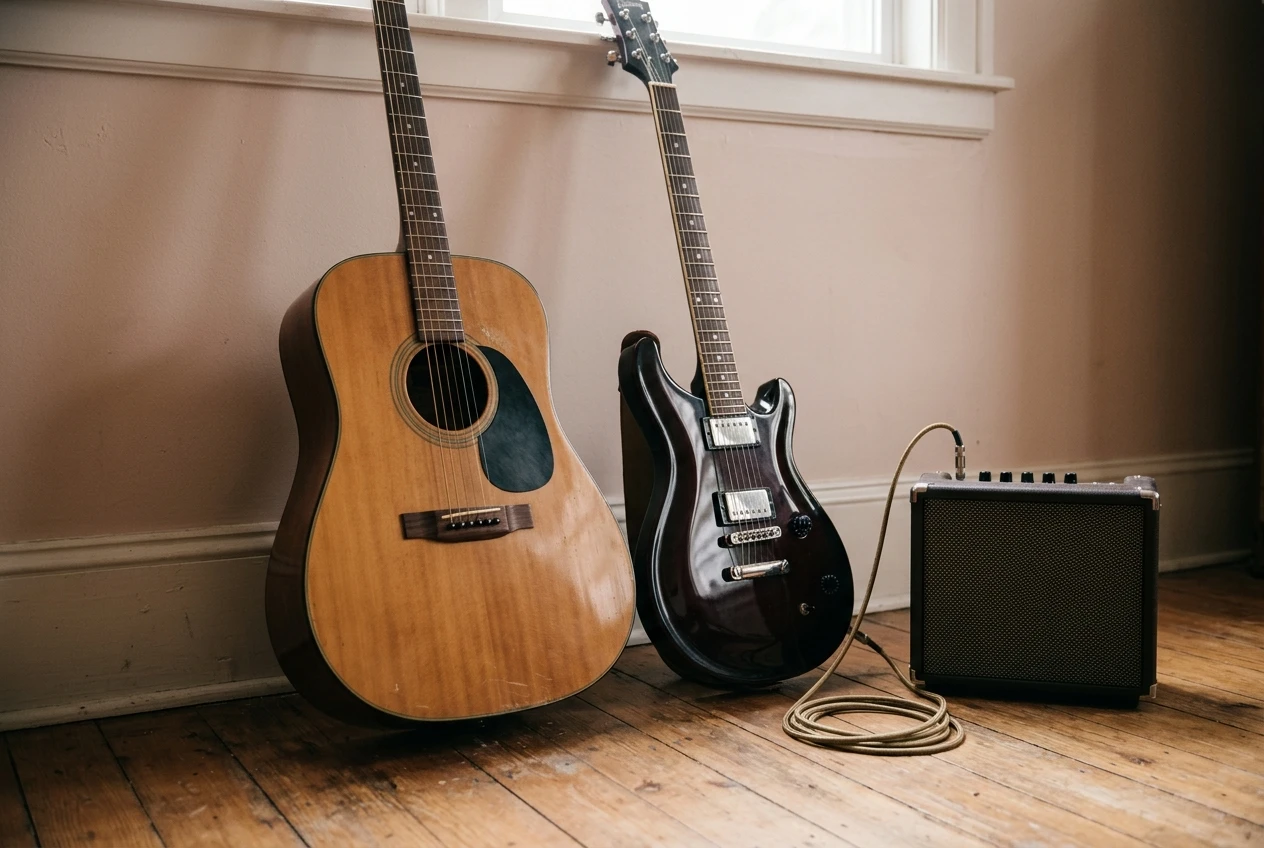
If you picture riffs, solos, or songs from bands that plug in, get an electric. Acoustic strings are harder on the fingers at the start, and learning on an instrument that sounds nothing like the music that got you interested can drain motivation fast. An electric needs an amp and a cable, which adds a small amount of cost and clutter, but it is not a reason to pick the wrong instrument for the music you actually want to play.
Classical (nylon-string) guitars are worth a separate mention only if you specifically want to play classical or flamenco style. They are also easier on the fingers for beginners, especially younger kids, hobbyists who don’t play every day, etc. For everyone else, they are not a shortcut. The wider neck can make early chord shapes harder, not easier. However, it makes more complex music, especially classical guitar, i.e. JS Bach, Villa Lobos, etc, easier to play via fingerstyle.
Pick the one that matches the music in your head. You can always own both later. I personally own several of each, nylon string, steel string, jazz guitar, electric guitars solid body and semi hollow, etc.
The guitar itself: what matters at beginner price points
At beginner prices, almost every guitar sounds roughly fine. However, guitars generally sound better and play better the more you invest, but not always. Do your research when consider what to buy at first.
What varies wildly is whether the guitar is set up to be played. Two things decide that: action and size.
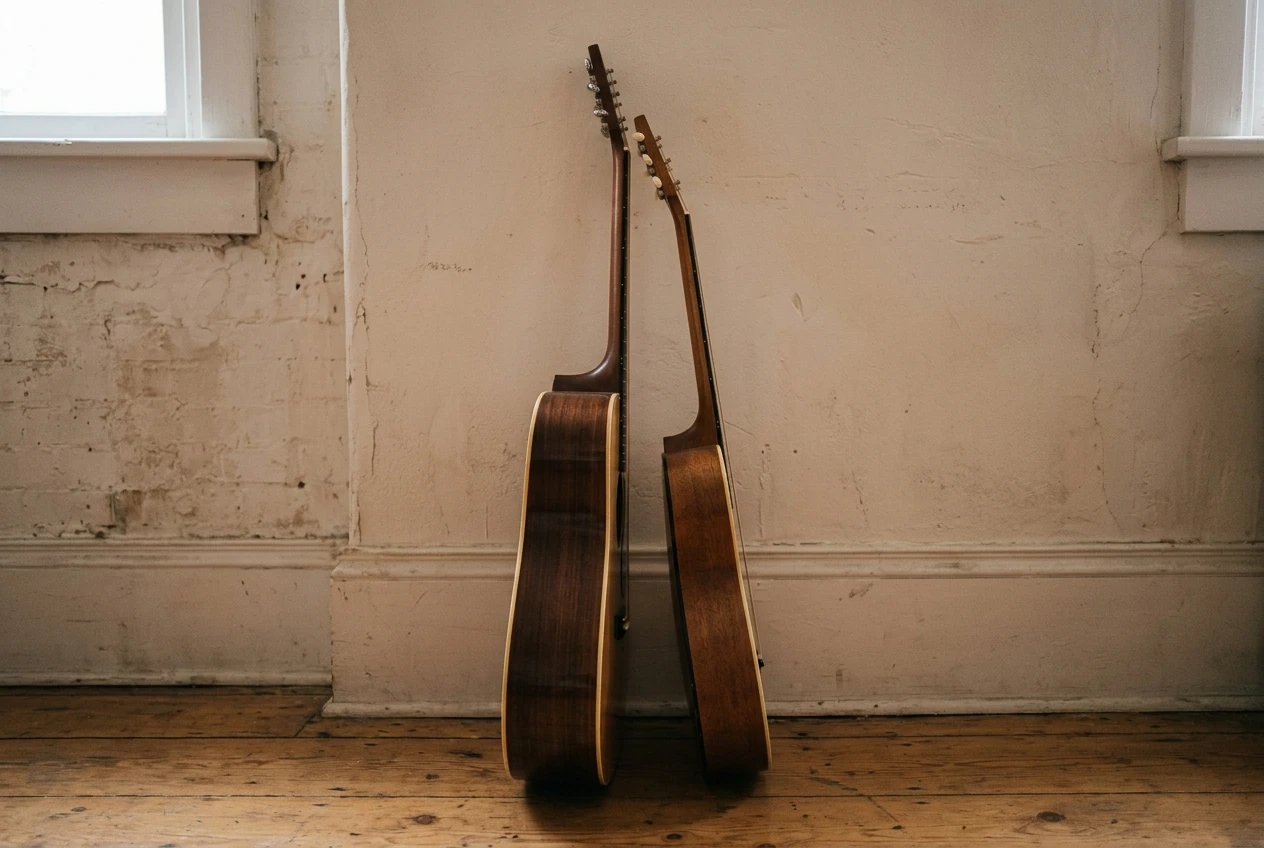
Action is the height of the strings above the frets. Too high, and every chord takes real finger strength and leaves your fingertips sore before you’ve learned three chords. A guitar with high action is the single most common reason beginners think they have “bad hands.” A quick setup by someone who knows what they’re doing can fix a guitar that otherwise feels unplayable.
Size matters more than most first-time buyers expect. A full-size dreadnought acoustic is a lot of guitar for someone with a smaller frame, and wrestling with the size of the instrument while also learning finger placement is two problems at once. If you’re petite, or buying for a teenager, look at a smaller body size or a shorter scale length rather than assuming full-size is the default. Look for 3/4 sized guitars or parlor sized guitars if you’re a smaller individual, or if it’s a gift for a child. There are even 1/2 sized guitars, and ukuleles can also also be a fun way to start a child on an instrument that’s like a guitar.
Beyond action and size, the differences between beginner-tier guitars are mostly cosmetic. However, wood type, quality of construction, quality of materials used, and for many players brand name matter far more once you’re choosing your second or third instrument, yet they can still be important for first time buyers also. Do some research before you make that purchase, to know if it’s a worthy investment or not. Ultimately, if possible, buy the one that feels right in your hands and has the action checked (or adjusted) before you take it home.
A tuner is not optional
A lot of new players skip the tuner, assuming they’ll “get a feel for it” or tune by ear once they know a few songs. This is one of the quiet reasons beginners plateau in month one.
An out-of-tune guitar sounds wrong even when your fingers are doing everything correctly. If you can’t tell the difference yet, which almost nobody can in the first few weeks, every chord you play will sound slightly off and you won’t know whether the problem is your tuning or your technique. That confusion is demoralizing in a way that’s easy to avoid entirely.
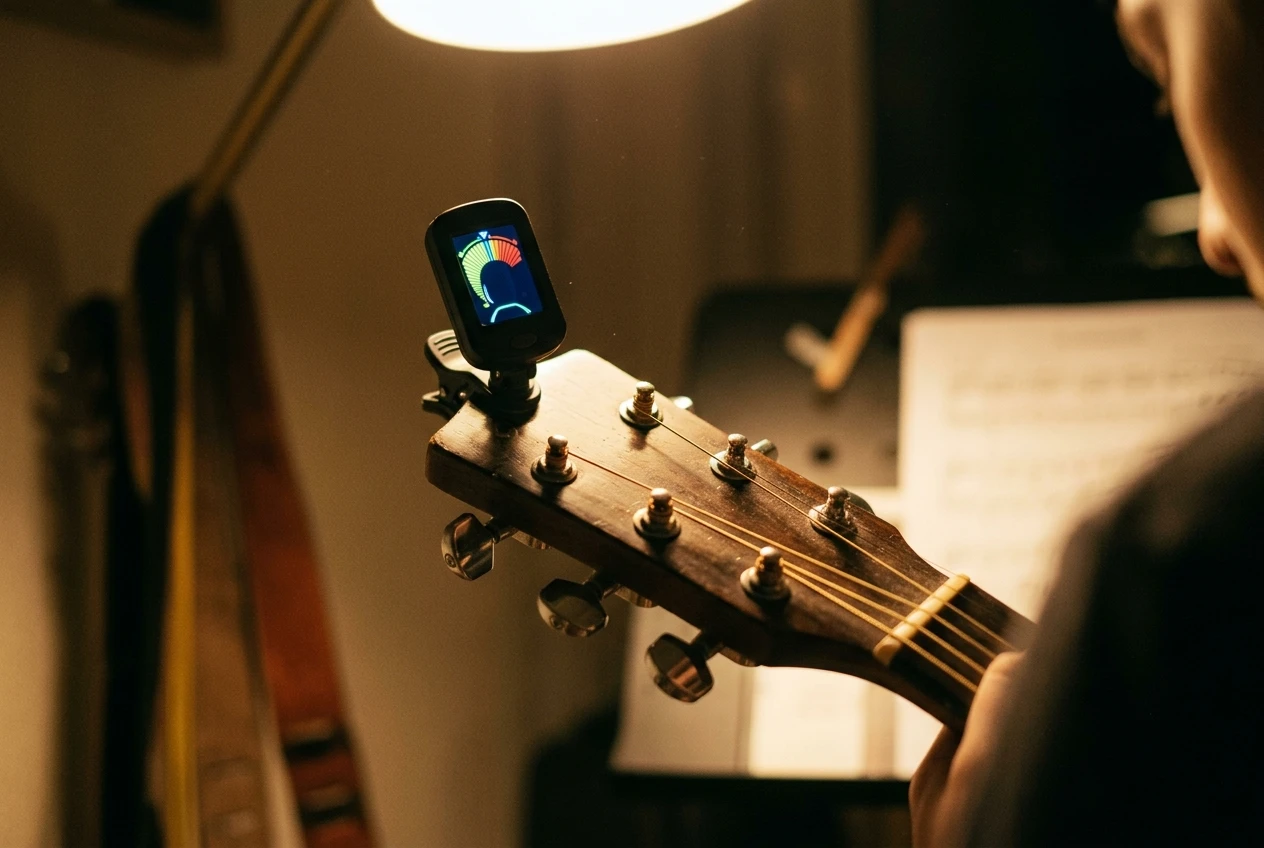
A clip-on tuner costs very little and removes the guesswork completely. Clip it to the headstock, tune before every practice session, and you’ve eliminated an entire category of frustration before it starts. This is the cheapest, highest-impact purchase on this list.
Picks, straps and cases: the cheap stuff worth buying right away
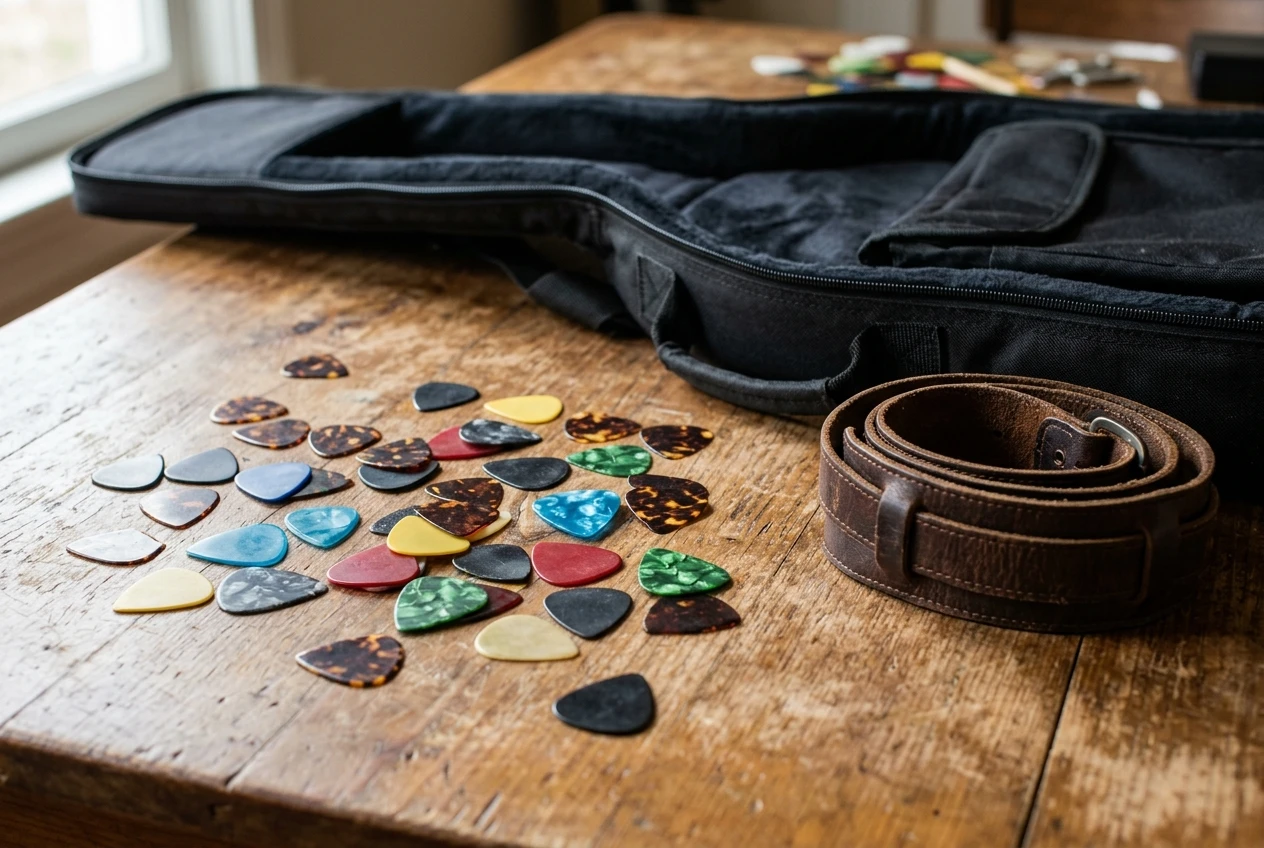
A few small, inexpensive items are worth buying on day one, not because they’re essential to survival, but because not having them creates small frictions that add up.
- Picks: buy a handful in different thicknesses (thin, medium, heavy). They cost almost nothing, and trying a few will tell you what feels natural in your hand faster than any article can. Thin picks are great for faster strumming (playing many strings at once), thicker picks are great for precise picking. Many players start with medium picks and go one way or the other after that based on preference, experimentation, advice from other players, etc.
- A strap: even if you mostly plan to sit and play, a strap lets you stand and play occasionally, which changes your posture and your motivation. Worth having even if you don’t use it every session. Like anything else, the more you pay for a strap, the better the quality of it, often the same with guitars, or any instrument really. More expensive leather straps are the most comfortable. Cheap straps are often hard, and uncomfortable, can bother your neck, etc. You can still get some non leather padded straps that are budget conscious, but also comfortable while using. By the way, I often show students how to use the strap both while sitting and while standing so that it doesn’t move much when someone goes from sitting to standing while playing, and vice versa.
- A case or gig bag: protects the instrument from dings, temperature changes, and the kind of accidental knock that happens when a guitar is left leaning against a wall. Many beginner guitars come bundled with one; if yours doesn’t, it can be worthy investment. Good cases, and even good gig bags aren’t always “cheap” in price, but can be in quality, especially if the gig bag comes with an inexpensive guitar. You might want to invest into a better quality gig bag that is padded to protect the instrument while leaving or entering buildings, etc, from the weather and from banging into the door frame for example, while walking in or out. A hard shell case is more expensive, but is worth the investment to protect instruments that often $1,000 USD or more. Very often, the best models come with one.
- A capo: not urgent in week one, but worth having within the first few months. It opens up a lot of songs that would otherwise require chord shapes beyond a beginner’s reach.
None of these items will make or break your progress on their own, but they remove small annoyances that otherwise chip away at the habit you’re trying to build.
Amps, cables and pedals: what to skip until you’re past the basics
This is where overwhelm usually sets in, because gear shops and gear sites are built to sell you more than you need. Here’s the filter: if an item changes your tone rather than your ability to practice, it can wait.
If you bought an acoustic, you need nothing else to start. No amp, no pedal, no interface. Resist anything that tries to upsell you here.
If you bought an electric, you need an amp and a cable, and that’s genuinely it for the first few months. A small practice amp, the kind built for bedrooms rather than stages, is enough to learn on. You do not need multiple amps, a pedalboard, or a tube amp with features you won’t use for a long time. Pedals in particular are a rabbit hole: they’re fun to research, and they solve problems you don’t have yet. Learning chords and switching between them cleanly has nothing to do with distortion or delay.
The same goes for accessories like capos with extra features, specialty cables, or guitar stands with built-in tuners. They’re not bad products, they’re just not where your first budget should go. Spend there later, once you know what you actually use.
Building a starter kit for under budget without buying twice
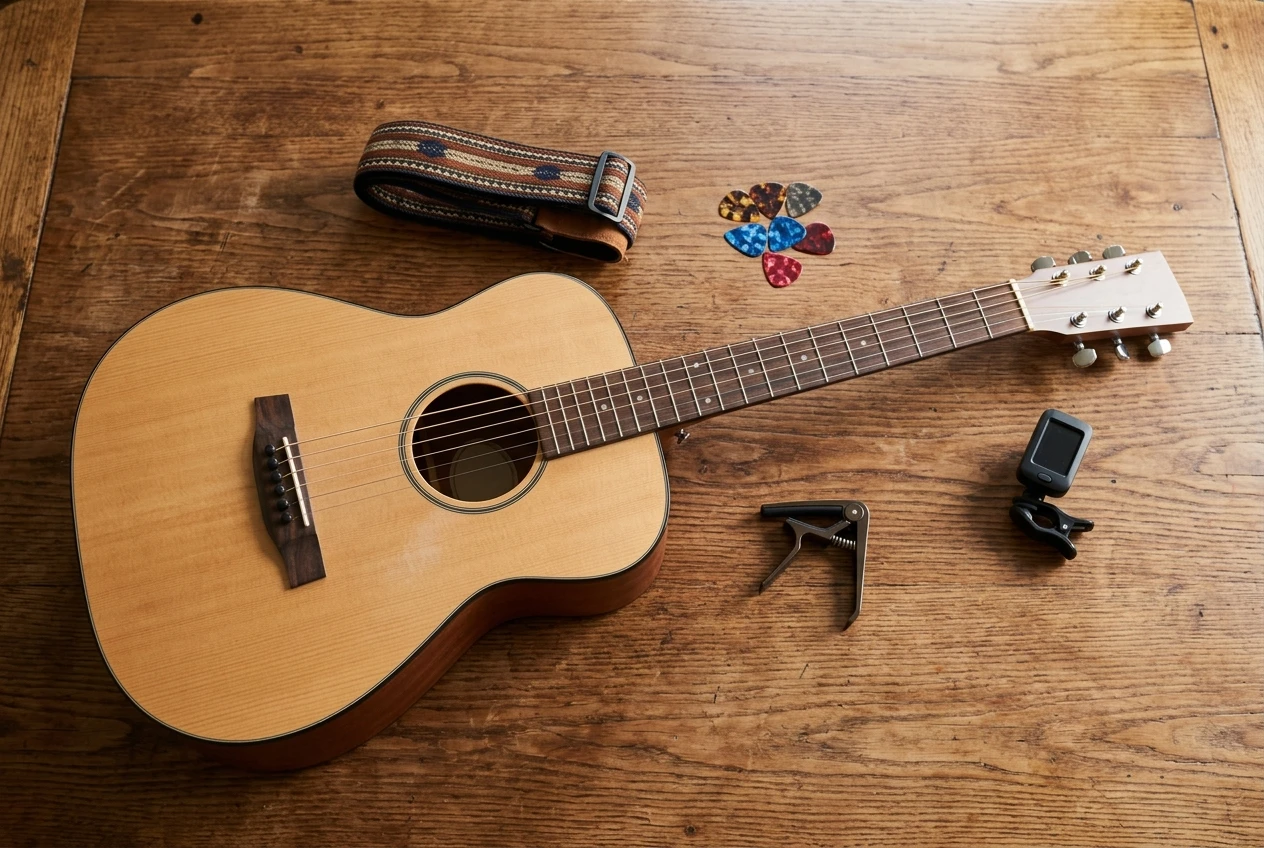
The cheapest kit is the one you don’t have to replace in month two because the first version made learning harder than it needed to be. Spend your budget in this order:
- The guitar itself, sized correctly, with the action checked.
- A clip-on tuner.
- A small set of picks.
- A strap and a case (often bundled with the guitar).
- An amp and cable, only if you bought electric.
- A capo, within the first month.
That’s the full list. Everything past it, pedals, a second guitar, upgraded strings, better cables, can wait until you know what you actually need instead of what a gear guide similar to this one, told you to want. I’m simply telling. you what you need!
Once your gear is sorted, the next decision that matters is how you actually learn to play it. If you want a clear starting point for your first lessons, Unleash Your Inner Guitar Hero is where to go next.